Guide
Flying with your bike: boxes, airline fees, and packing
Bringing a bike on a flight isn't as dear or as daunting as it first looks — once you know what the airline charges, what to pack it in, and how to stop a baggage handler ruining your week away.
What the airlines charge
Both Aer Lingus and Ryanair carry a boxed bike as sports equipment, and on almost every route it's charged on top of your normal baggage allowance rather than inside it. The two work differently enough to be worth setting out separately — these were checked against each airline's own pages on 27 July 2026:
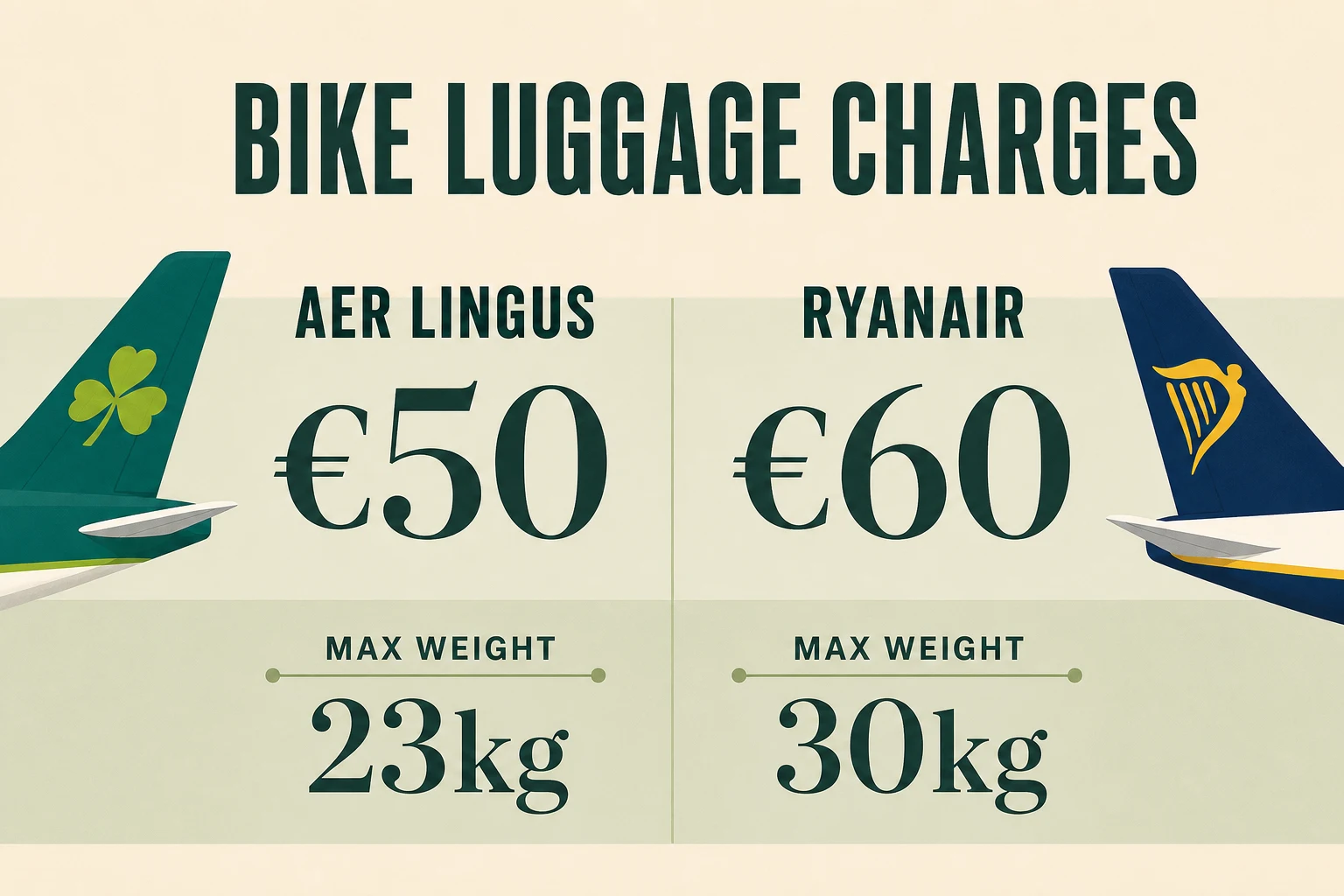
- Aer Lingus — €50 each way, with a 23kg limit. You can't add a bike online: it's paid through the reservations centre or at the airport on the day. Ring ahead regardless, because spaces are capped per flight — ten on most routes, fewer on some, one on Aer Lingus Regional — and an unconfirmed bike travels stand-by. On North American routes the bike counts inside your checked allowance instead, and it travels free in business class. Aer Lingus sports equipment
- Ryanair — €60 added when you book, €75 afterwards or at the airport, with a more generous 30kg limit (€13 per kilo over it). It never counts inside your checked bags, and electric bikes aren't carried at all. Ryanair table of fees
The 23kg cap on Aer Lingus is the one that catches people. A hard box can weigh 11–13kg empty, so it leaves less for the bike than you'd expect — worth weighing the packed box at home rather than discovering it at the bag drop. Fees do move: we re-check these every three months, but the airline's own page is the last word on the day you book.
Hard box, cardboard, or soft bag?
You've three real options for what to fly the bike in, and they trade protection against weight and hassle:
- A hard bike box is a rigid plastic shell with wheels to drag it and moulded padding inside. It's the safest by a distance: a handler can stack a suitcase on top and your frame won't notice. It's also the bulkiest, and heavy before the bike even goes in (often 11–13kg empty), which eats into that weight cap.
- A cardboard bike box from a bike shop is nearly free, and fine if you pack it carefully, but it's a one-trip item that goes soft in the rain and offers little against a hard knock.
- A padded soft bag is lighter and far easier to store than a hard box, but gives the least protection. Best for riders who pack meticulously and travel often.
For a hard-earned road or gravel bike making one or two trips a year, a hard box is the sensible middle ground — if only you didn't have to own one. More on that below.
A packing checklist that survives baggage handlers
Whatever you pack it in, the drill is much the same. Give yourself an hour the first time and it'll take twenty minutes after that:
- Take the pedals off. Remember the left one is reverse-threaded — lefty-loosey doesn't apply, so it loosens clockwise.
- Turn the handlebars in line with the frame, or unbolt the stem and cable-tie the bars alongside the top tube.
- Take the rear derailleur off its hanger and tuck it against the frame, or at least pad it well — a bent hanger is the classic flight injury.
- Let some air out of the tyres, but don't fully deflate them. A bit of pressure protects the rims; flat does nothing, and airlines don't actually require it.
- Slot the plastic spacers into the fork dropouts and any thru-axle gaps so nothing gets crushed if the box is squeezed.
- Pad the frame tubes where they'll rub, with pipe lagging or the foam the box came with.
- Keep your multi-tool and any loose bits in your checked suitcase, not the bike box — some airlines won't accept tools in the bag, and it's one less thing to go missing.
Where to get a box without buying one
Here's the snag with the hard box. A good one costs €400 or more, and just like the roof box in our other guide, it gets used twice a year and then swallows a corner of the garage. Buying one outright for a single sportive abroad is a lot of money and storage for a fortnight's use.
So borrow one instead. On BoxShare you can request a bike box from a neighbour for your travel dates and agree a deposit directly with the owner; if none's free nearby, post what you need and the nearest owners will see it. One box, packed and flown a dozen times a year by different people, beats a dozen boxes gathering dust in a dozen sheds.
Flying somewhere with the bike?
See which bike boxes are free near you for your dates — or post what you're after and let the nearest owners come to you.
Find a box